

Listening to the voices of water
Sealing so tight, not a drop gets through
- People


See it, feel it, touch it
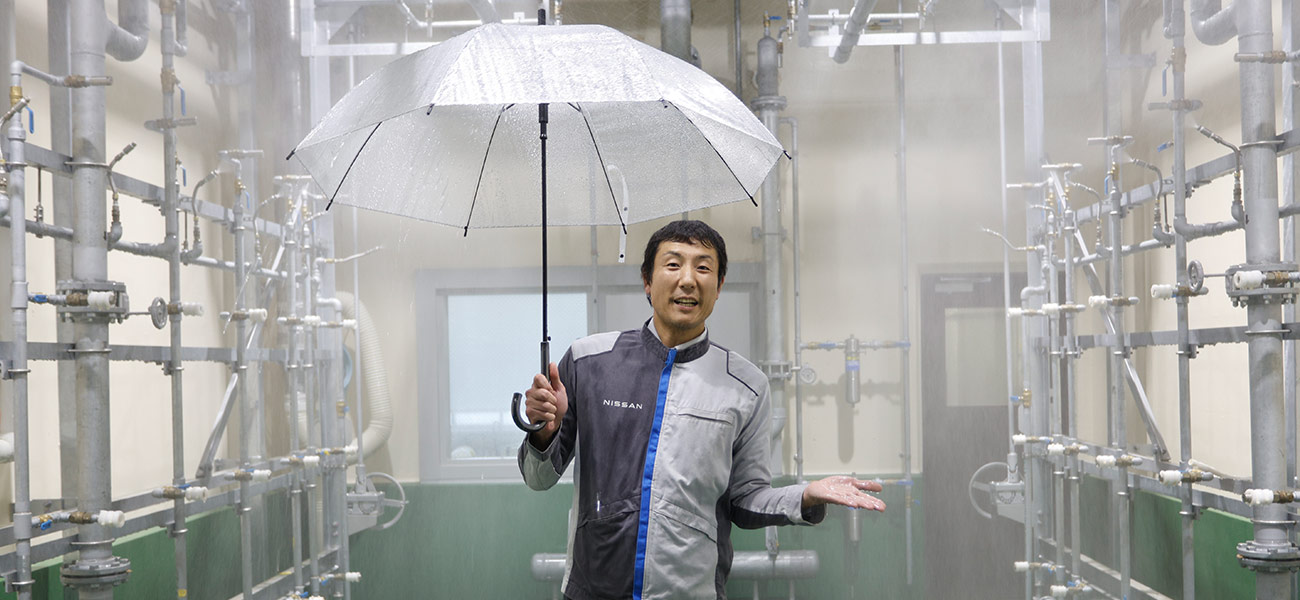
At the rain-test facility at Nissan Technical Center (NTC) we meet with Wataru Funasaka, and he casually remarks, "I can gauge the rainfall intensity just by standing in it."
"See it, feel it, touch it, and you'll understand it." One can almost sense a feeling of a sixth sense at work here when one hears Funasaka speak about water, a skill honed and perfected after years of dedication and commitment to this craft.
Just before the start of mass production of a new vehicle, water leakage was discovered inside the door of a final-stage prototype. "It was a significant leak," recalls Wataru Funasaka, Technical Expert for Door System Performance Evaluation (Water Sealing), whose job is to ensure vehicles are protected against water intrusion into the cabin. Only a little over a dozen prototype vehicles existed at that stage. The leak was found in one vehicle. Just one vehicle. Yet if that incident represented a failure rate approaching 10%, it was something that simply could not be ignored by the team. The search for the root cause began, and the team spent the next few days investigating.
Listening to the voice of water: How engineers keep the cabin dry3:54
Tracing the water's path
Where does water enter a vehicle in the first place? By examining where water enters first inside the cabin, Funasaka can trace its path through the door structure and determine where and why it entered.
In fact, water entering the inside of a door is expected. Vehicle doors contain a cavity between the outer and inner metal panels, housing the door lock mechanism, window regulator, wiring harnesses, and other components. Rainwater entering this area is anticipated by design.
The final barrier preventing that water from reaching the cabin is the system of rubber seals and weatherstrips. The problem in this case was that water had breached that final line of defense. So, the question was - why did water designed to be contained cross the last barrier? This question marked the beginning of Funasaka and his team's investigation. The rubber seals around the door contain numerous subtle design features that help prevent water intrusion.
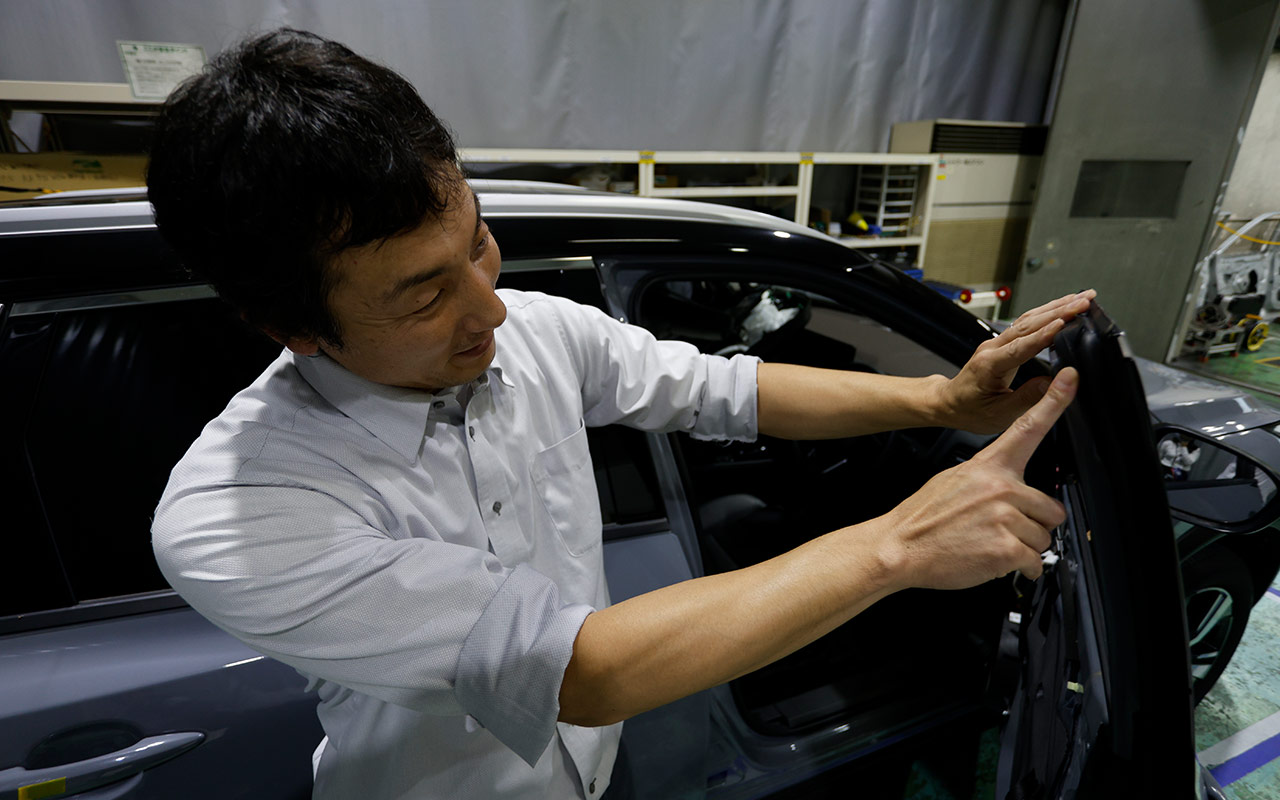
The rubber around the door is packed with fine details designed to block water.
Protecting Nissan quality around the world
Funasaka leads a globally connected team based in Japan. While ensuring the quality of vehicles produced domestically, he has also trained numerous technical engineers at manufacturing plants around the world, many of whom he considers his students. These technical engineers apply the same rigorous standards to water-sealing performance wherever Nissan vehicles are built.
From Mexico to other manufacturing plants worldwide, they conduct the same tests up to the start of mass production and verify that all vehicles meet Nissan's requirements. Together, this team safeguards the watertightness of Nissan vehicles around the globe.
Developing both the people and the technical expertise needed to maintain those standards worldwide is also part of Funasaka's role.
"Delivering the same level of quality for every Nissan vehicle, everywhere in the world. This is what we strive for every day," says Funasaka. "To ensure customers around the globe can trust and be satisfied with Nissan quality, I also focus on developing the people who will carry those standards forward. Across our teams in the United States, the United Kingdom, Thailand, Mexico, China, and beyond, we share the same testing methods, the same mindset, and the same commitment to quality.
An unexpected cause: Harness stiffness
For over three days, Funasaka and his team focused all their efforts on tracing the path of a single drop of water. The root cause they eventually uncovered was surprisingly straightforward and unexpected: the stiffness of the wiring harness. "The harness was secured to the inside of the door, but one of the retaining clips had lifted slightly. This created a gap in the rubber seal, allowing water to enter the cabin."
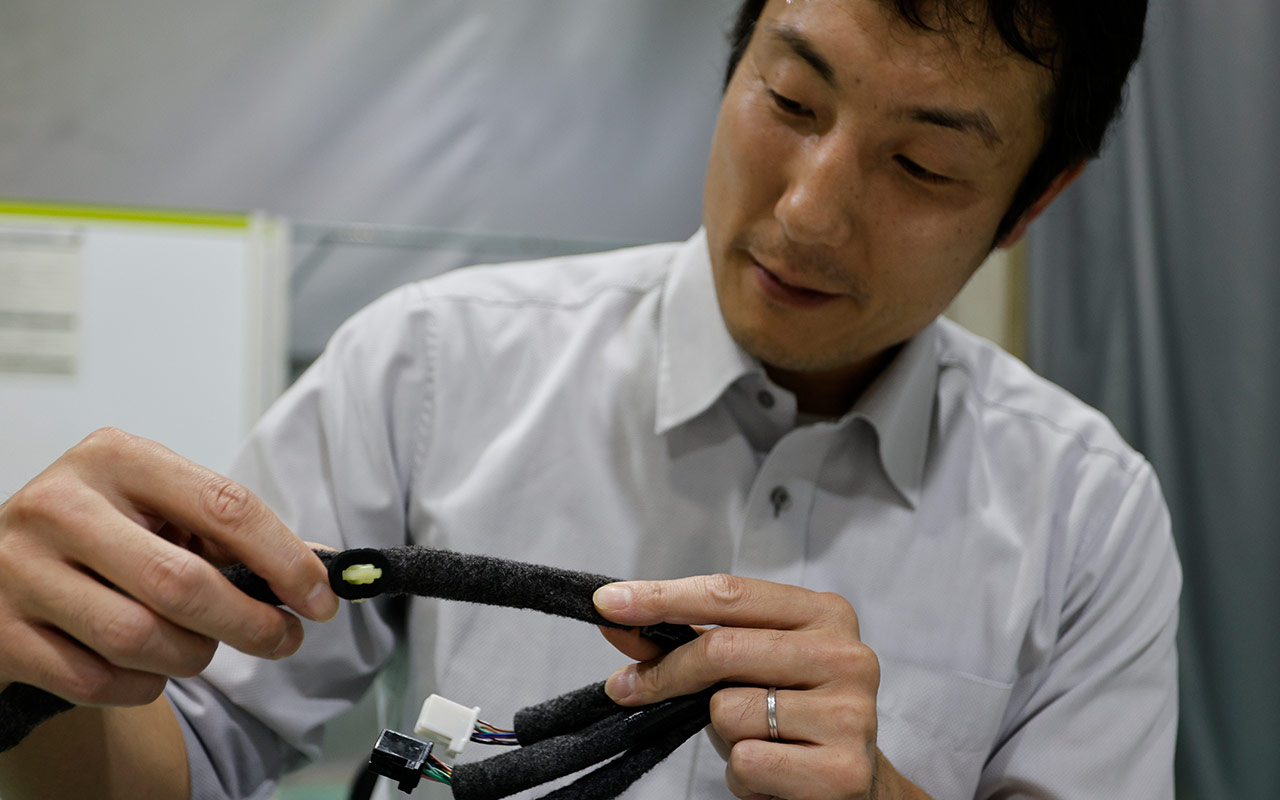
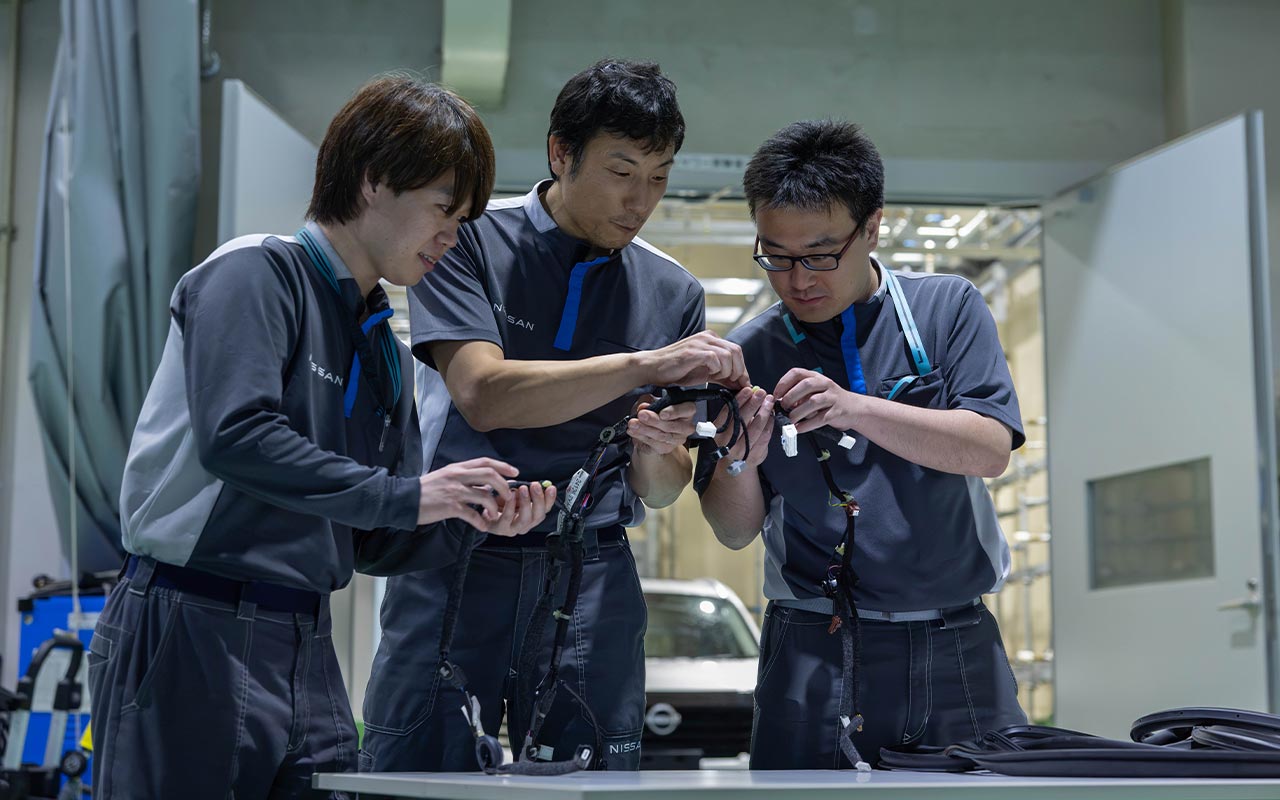
Funasaka examining a wiring harness, whose stiffness once became the root cause of a water leak discovered during pre-production testing.
The harness had developed a curved shape due to stiffness, generating force that gradually pulled the clip away from its mounting position. Even this tiny gap was enough for water to pass through. A design modification was immediately requested, and the vehicle entered mass production as scheduled. The stiffness of the harness turned out to be the cause of the leak.
Gauging water pressure by touch
Rain is not the only source of water intrusion. Water can also enter around window frames, doors, sunroofs, and other openings during vehicle washing. For customers, a leak-free vehicle is simply expected. That is precisely why Nissan subjects its vehicles to extensive testing designed to simulate real-world situations experienced by customers around the world.
・Heavy rain.
・Driving through severe downpours.
・Washing with household pressure washers.
・High-pressure automated car washers at gas stations.
Each scenario is carefully recreated, and only vehicles that meet Nissan's stringent water-sealing standards are released to customers. These demanding tests are not limited to a few premium models. From the Kei car Roox to the all-new Kicks and all-new Elgrand, Nissan applies the same water-sealing standards across a remarkably broad range of vehicles.
This reflects a fundamental principle of Nissan manufacturing:
Customers expect every vehicle to be leak-free, regardless of size, price point, or market. Nissan therefore holds every single vehicle to the same standard. However, water sealing requires balance.
"There is also the issue of door closing performance," says Funasaka. "If you focus solely on making the vehicle completely airtight, the door becomes difficult to close. Excessive airtightness can also create pressure changes that cause discomfort, such as a popping sensation in your ears when opening or closing the door."
While a power sliding door could address some challenges, but this introduces its own design constraints.
Take the Nissan Z, for example, which uses frameless (sash-less) doors. This presents unique challenges in balancing a sporty design with weather sealing. Since the Z33 generation, Nissan has maintained cabin sealing by designing the edge of the side window glass to fit tightly into the rubber weatherstrip when the window is fully closed. To enable smooth door operations, the glass automatically lowers by about one centimeter when the door is opened or closed, a mechanism known as partial down. This illustrates how design, usability, engineering, and water-sealing performance must all work together to prevent leaks.
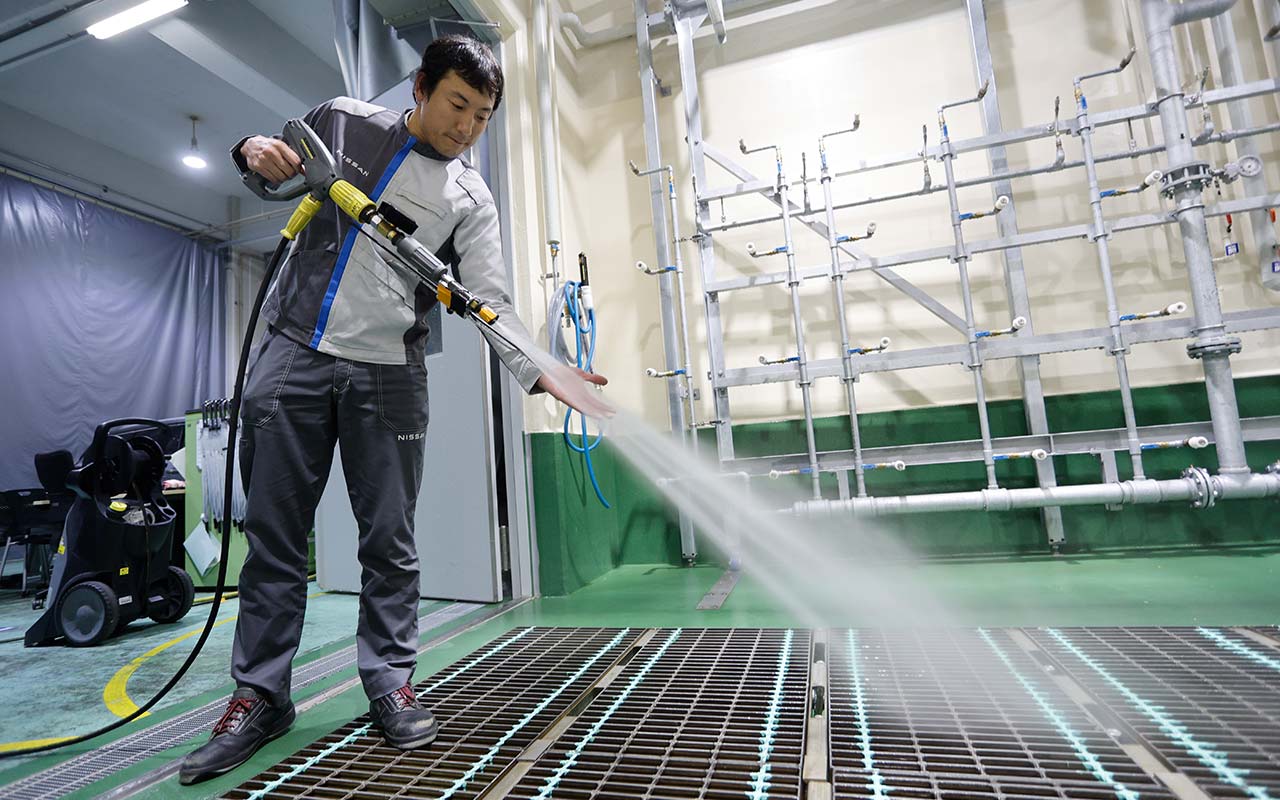
After testing countless high-pressure washers, he says, "I can feel the water pressure."
Today's right answer may not be right tomorrow
Ten years from now, vehicle architecture and market conditions may evolve in ways that go far beyond what we can imagine today. Engineers must understand the circumstances they face and determine the most appropriate solutions for each situation.
Today, Funasaka is focused on passing on his expertise, testing methodologies, and approaches to developing new standards for the next generation. "When people face a problem, they do not truly learn if they are simply given the answer. A solution that was correct ten years ago may no longer be correct today. That is why it is essential to keep thinking for yourself."
Rather than providing ready-made answers, he encourages every member of the team to think independently and deeply. By doing so, the instincts and insights he has developed become more than a personal experience. They become a shared asset passed down through generations of engineers, ensuring the continuance of Nissan's commitment to quality.
"Continuing to search for better answers is what drives innovation."
Subscribe to Nissan Stories
Sign up to receive the latest Nissan stories!